
Guests
Amédée
On this page
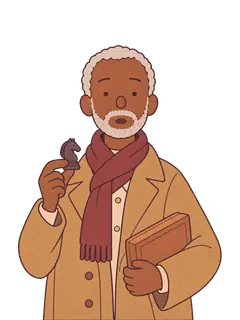
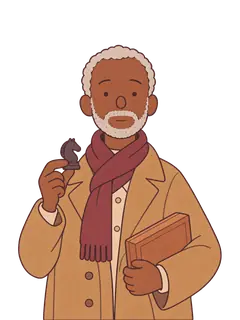
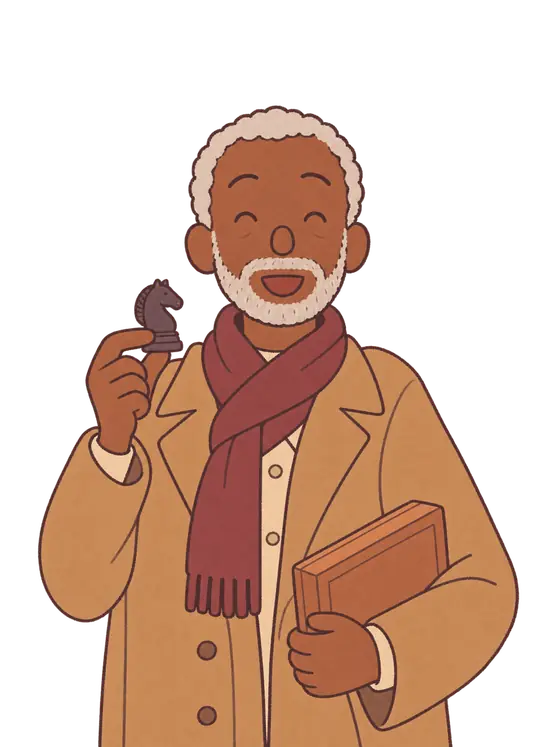
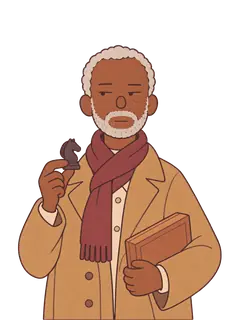
Their faces
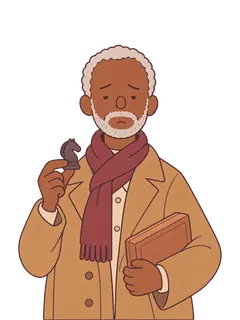
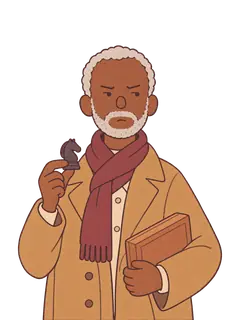


What Amédée says
How they order
Amédée has 18 written orders, heard over the year as the kitchen learns new fillings and techniques; after those, the game makes up more in the same voice. A few of them:
“I resign myself to the obvious: raspberry jam and strawberries. A triangle. Golden.”
In plain words Raspberry jam and strawberries. A triangle. Golden.


“The opening I always play: lemon and sugar, three corners. Golden. Predictable, I know.”
In plain words Lemon and sugar. A triangle. Golden.

“Black and white, like my board: the dark hazelnut spread, a white cloud. Pale.”
In plain words Chocolate-hazelnut and whipped cream. A triangle. Pale and soft.


“Knight takes... no. Chocolate. Chocolate and banana, three corners. Golden.”
In plain words Chocolate-hazelnut and banana. A triangle. Golden.

In Amédée’s words
When Amédée makes an order up, these are the words for a fold and for how it is cooked:
| They mean | They say |
|---|---|
| Triangle | “three corners, on the diagonal” |
| Square envelope | “closed four ways, castled” |
| Rolled | “rolled tight as a rook” |
| Pale and soft | “pale as the white pieces” |
| Golden | “golden as boxwood” |
| Crisp | “crisp as a clean endgame” |
The usual
Once Amédée has a favourite, the order stops being spelled out: the usual is La Citronnette, golden. It sounds like this: “My opening, Madame. The usual.” See the usual.
Not sure what they mean? Ask. See orders.
Amédée’s story: The long game
“The long game” unfolds over five visits, told a little at a time across the counter. Somewhere along it comes a question, and your answer changes one thing you will see and one thing the till feels. Both answers are kind; neither is wrong.
“I play a man in Quimper by postcard. One move a week. We began three years ago.”
— how it begins
Spoiler The whole of “The long game”, its question and its keepsake
- “I play a man in Quimper by postcard. One move a week. We began three years ago.”
- “A boy of thirteen sat down at my table and beat me in eleven moves. Hood up. Very polite.” This visit introduces Léon.
- “I am not sulking. I am analysing. There is a difference, and I shall find it.”
- “The boy wants a rematch every day. I want a week to think. What do I do with him?”
- “Quimper is a draw. A hundred and fifty-six postcards. We shook hands by letter. (or, after the other answer: “Quimper is a draw after three years. The boy says next year he will beat us both.”)”
The question: What should Amédée do about Léon?
- Teach him. Amédée: “Teach him. Yes. He has the attack; I have a lifetime of defending. A fair trade.” (Amédée tips 10% more on his visits: a teacher again.)
- Play him by postcard too. Amédée: “By post! He will loathe the waiting. It will be the making of him.” (One more postcard a week: Bastien is on that round anyway.)
From the terrace table: The white queen from Amédée's set: 'She did all the work and never once complained.'

Amédée's white queen Boxwood, worn smooth at the crown. She played every move of the long game with Quimper.
In the street’s second year
The story does not stop at the end of the first year: Amédée has a postscript in the second.
Spoiler Amédée’s postscript
- “A new game with Quimper. I opened with a move Léon taught me. Quimper was furious.”
- “My hands were cold on Sunday. Léon moved my pieces for me. I told him which. Mostly.”
- “Quimper wants to come and play at my table. Face to face, after four years. I am nervous.”
Who Amédée knows


Around the street
Amédée also has a word to say in 1 of the street’s little moments.
Presents
From Yann the pedlar’s cart, Amédée would love a travel chess set and a chequered tin of biscuits.
Friendship
Spoiler What Amédée says as you become friends
As you become friends:
- A regular: “You are a regular opponent now. I have set up a board for you.”
- A friend: “I have told Quimper about you. He sends his respects, by post.”
- A dear friend: “I would let you play white. I let nobody play white.”
- Family: “Two friends at the board all my life. Now three. You count, Madame.”
When a present arrives:
- “A travel set! The pieces have pegs. The wind can do its worst.”
- “Black squares and white. I shall eat the black ones first.”