
Guests
Jean-Yves
On this page
Their faces
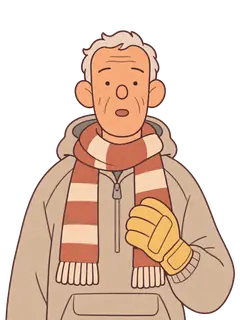
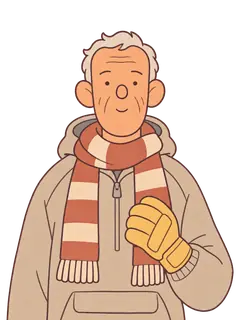
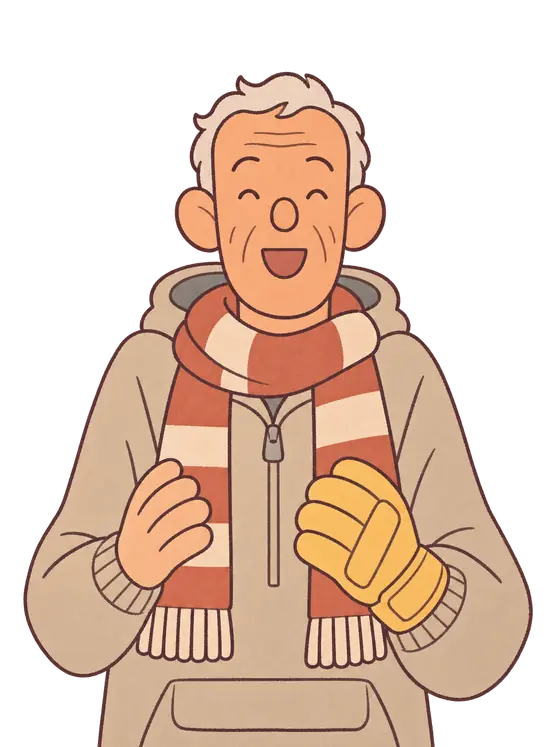
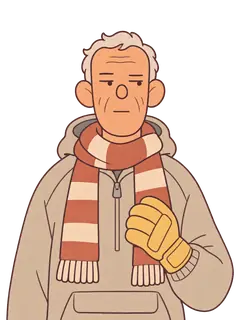
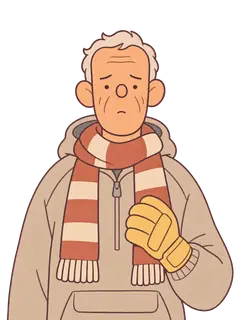
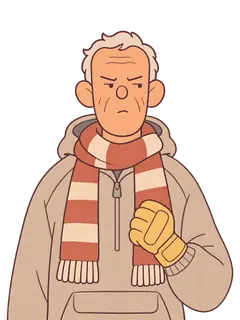


What Jean-Yves says
How they order
Jean-Yves has 11 written orders, heard over the year as the kitchen learns new fillings and techniques; after those, the game makes up more in the same voice. A few of them:
“Extra time needs a galette: ham and Emmental on buckwheat, square. Golden.”
In plain words Ham and Emmental on buckwheat. A square envelope. Golden.


“Into the top corner: chocolate and banana, three corners. Golden.”
In plain words Chocolate-hazelnut and banana. A triangle. Golden.


“A muddy-pitch galette: little brown caps from the woods, and cheese. Square. Crisp.”
In plain words Mushrooms and Emmental on buckwheat. A square envelope. Crisp.

“A clean sheet: just butter, three corners. Pale. Nothing got past.”
In plain words Butter. A triangle. Pale and soft.

In Jean-Yves’s words
When Jean-Yves makes an order up, these are the words for a fold and for how it is cooked:
| They mean | They say |
|---|---|
| Triangle | “into the top corner” |
| Square envelope | “square as the goal box” |
| Rolled | “rolled like a team scarf” |
| Pale and soft | “pale as the old home shirt” |
| Golden | “golden as a cup final” |
| Crisp | “crisp as a frosty pitch” |
The usual
Once Jean-Yves has a favourite, the order stops being spelled out: the usual is La Gourmande, golden. It sounds like this: “The usual. Top corner.” See the usual.
Not sure what they mean? Ask. See orders.
Jean-Yves’s story: The under-tens
“The under-tens” unfolds over four visits, told a little at a time across the counter. Somewhere along it comes a question, and your answer changes one thing you will see and one thing the till feels. Both answers are kind; neither is wrong.
“The town lost again. The keeper's twenty and terrified. I said nothing. I wanted to.”
— how it begins
Spoiler The whole of “The under-tens”, its question and its keepsake
- “The town lost again. The keeper's twenty and terrified. I said nothing. I wanted to.”
- “They've asked me to coach the under-tens. Capucine plays. She gives my coaching marks.”
- “They've never won a match. I said I'd bring crêpes. After a win, or after every game?”
- “They won! Two-one. Capucine scored, then gave herself ten out of ten. The ball's for you. (or, after the other answer: “Two-one! Capucine scored, then marked herself ten. Fed all season, win or lose. For you.”)”
The question: When do the under-tens get crêpes?
- After every match. Jean-Yves: “Every match, win or lose. That's how I'd have wanted it at nine.” (School-run families tip 10% more: their children come home happy.)
- After their first win. Jean-Yves: “After a win. Something to play for. They'll be unbearable about it. Good.” (The week the chase begins: one more guest a day, parents talking up Saturday's match.)
From the under-tens: The ball from their first win, signed by nine-year-olds in felt pen. Some letters backwards.

The under-tens' match ball Signed by the whole team, mostly legibly. Capucine's name is the biggest.
Who Jean-Yves knows


Presents
From Yann the pedlar’s cart, Jean-Yves would love a new team scarf.
Friendship
Spoiler What Jean-Yves says as you become friends
As you become friends:
- A regular: “Six of the old team still meet. We argued about you. You won.”
- A friend: “If you ever drop a plate, I'm here. That's a promise, not a joke.”
- A dear friend: “You're on my all-time team now. Between the left-back and the coach.”
- Family: “I've pencilled you onto the old team photo. Back row. Our cook.”
When a present arrives:
- “Terracotta and cream! The old scarf can retire now. Like me.”