
Guests
Monsieur Le Bihan
On this page
Their faces
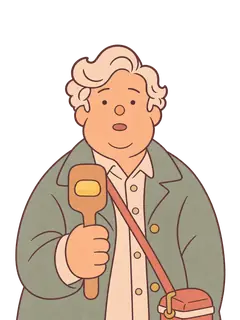
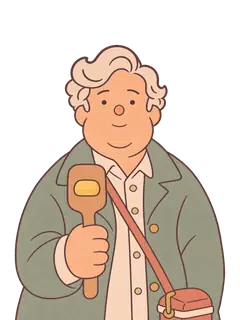
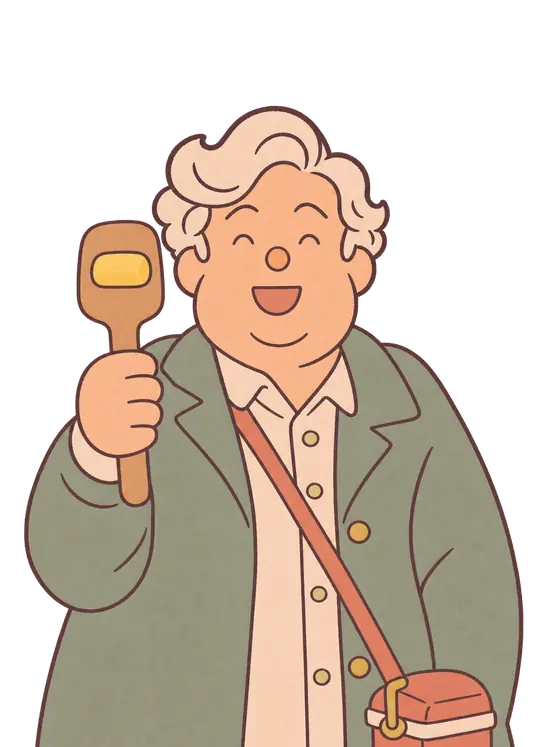
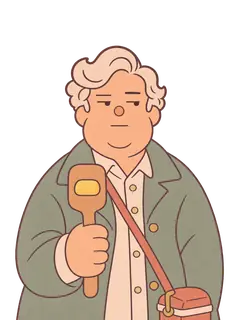
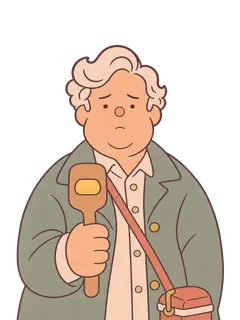
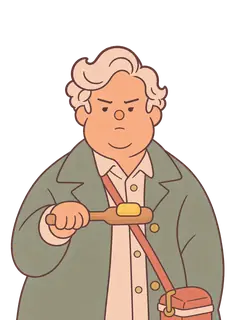


What Monsieur Le Bihan says
How they order
Monsieur Le Bihan has 18 written orders, heard over the year as the kitchen learns new fillings and techniques; after those, the game makes up more in the same voice. A few of them:
“Salted butter. Always salted. And a little more salted. Three corners. Golden.”
In plain words Salted butter. A triangle. Golden.

“Apple compote, to prove butter goes with anything. Rolled like a log. Golden.”
In plain words Apple compote and butter. Rolled. Golden.

“Sugar boiled in butter till it blushes brown. More butter under it. Rolled. Crisp.”
In plain words Salted caramel and butter. Rolled. Crisp.

“Butter down first, as is proper. Maple syrup over it. Rolled. Pale as fresh cream.”
In plain words Maple syrup and butter. Rolled. Pale and soft.

In Monsieur Le Bihan’s words
When Monsieur Le Bihan makes an order up, these are the words for a fold and for how it is cooked:
| They mean | They say |
|---|---|
| Triangle | “three corners” |
| Square envelope | “wrapped like a pat” |
| Rolled | “rolled like a butter log” |
| Pale and soft | “pale as fresh cream” |
| Golden | “golden as best butter” |
| Crisp | “crisp at the rim” |
The usual
Once Monsieur Le Bihan has a favourite, the order stops being spelled out: the usual is La Toute Simple, golden. It sounds like this: “The usual. Salted.” See the usual.
Not sure what they mean? Ask. See orders.
Monsieur Le Bihan’s story: The churn
“The churn” unfolds over five visits, told a little at a time across the counter. Somewhere along it comes a question, and your answer changes one thing you will see and one thing the till feels. Both answers are kind; neither is wrong.
“Found my grandfather's churn in the barn loft. Oak. It still turns, if you shout at it.”
— how it begins
Spoiler The whole of “The churn”, its question and its keepsake
- “Found my grandfather's churn in the barn loft. Oak. It still turns, if you shout at it.”
- “There was a butter fair on the square once. Stamps, pats, a ribbon. I'd like it back.”
- “I've churned a pat by hand, like he did. One crêpe's worth. Will you cook with it?”
- “Here it is, wrapped in his paper. It should go to someone who knows butter.”
- “The butter fair is back. One table, one ribbon. I stamped the first pat with a lantern. (or, after the other answer: “Butter fair's back. Armand walked past my stall and nodded. From him, a speech.”)”
The question: Who gets the hand-churned crêpe?
- Armand, across the street. Monsieur Le Bihan: “Armand. Bold. He'll pretend it's nothing. Watch the moustache.” (Armand drops in a little more often: 10% more visits.)
- Mamie Hortense. Monsieur Le Bihan: “Hortense. She'll say hers is better and eat every crumb. Perfect.” (Hortense drops in a little more often: 10% more visits.)
From the butter fair: A wooden butter stamp carved with a lantern. Pressed into a pat, it leaves a little light.

A lantern butter stamp Pear wood, his grandfather's. The lantern is newly carved. The salt in the grain is old.
In the street’s second year
The story does not stop at the end of the first year: Monsieur Le Bihan has a postscript in the second.
Spoiler Monsieur Le Bihan’s postscript
- “The butter fair's a fixture now. Two stalls this year. The second one is also mine.”
- “A school class came up to the farm to see the churn. Lundi showed off dreadfully.”
- “Next year, three stalls. I'll need a bigger cap.”
Who Monsieur Le Bihan knows


Around the street
You will hear from Monsieur Le Bihan at La Fête des Rois (January) and The big market (April).
Spoiler The chapters Monsieur Le Bihan has a part in
Monsieur Le Bihan turns up in The cold oven and The Rois bean.
Presents
From Yann the pedlar’s cart, Monsieur Le Bihan would love a butter dish with a cow lid and a striped cotton cap.
Friendship
Spoiler What Monsieur Le Bihan says as you become friends
As you become friends:
- A regular: “I save you the corner of the block now. The best salt's there.”
- A friend: “Hortense asked whose crêpes I eat. I said yours. She sniffed. Kindly.”
- A dear friend: “I've named a calf after the shop. La Lanterne. She's very bright.”
- Family: “Fifty years of butter, Madame, and you make it taste like I meant it.”
When a present arrives:
- “A cow on the lid! I'll call her Samedi. She'll guard the salt.”
- “A new cap. The old one has opinions. I'll wear them in turns.”