
Guests
Odile
On this page
Their faces
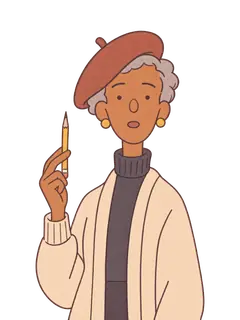
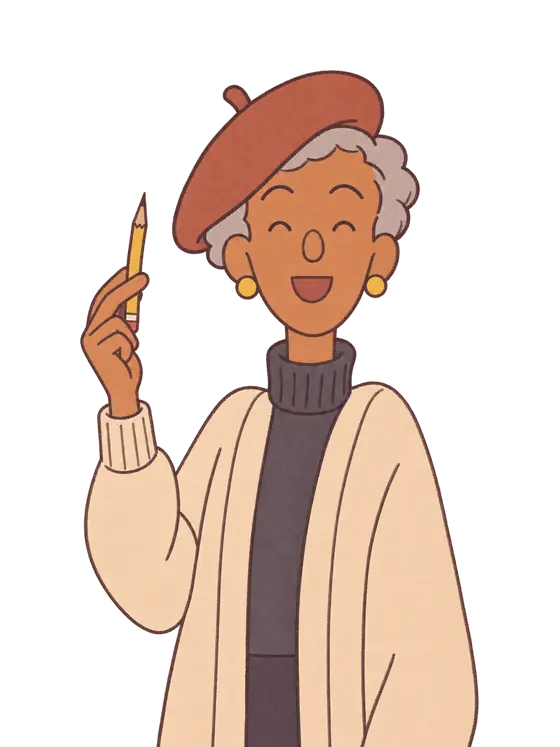
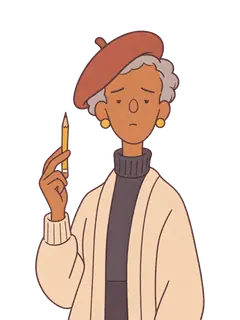
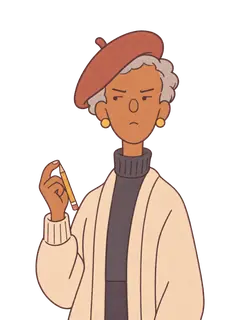


What Odile says
How they order
Odile has 8 written orders, heard over the year as the kitchen learns new fillings and techniques; after those, the game makes up more in the same voice. A few of them:
“A galette: mushrooms and goat's cheese, sealed. Crisp. An easy one. For you.”
In plain words Mushrooms and goat's cheese on buckwheat. A square envelope. Crisp.


“Clue: what the hive stores for winter, poured. Rolled. Crisp. No letter count. Ever.”
In plain words Honey. Rolled. Crisp.

“Lemon and sugar, triangle, pale. No clue at all today. I'm resting my pencil.”
In plain words Lemon and sugar. A triangle. Pale and soft.

“Clue: the fruit with a waist, sliced, under the hazelnut spread. Three corners. Golden.”
In plain words Pear and chocolate-hazelnut. A triangle. Golden.


In Odile’s words
When Odile makes an order up, these are the words for a fold and for how it is cooked:
| They mean | They say |
|---|---|
| Triangle | “cut to three corners” |
| Square envelope | “boxed in, four sides” |
| Rolled | “rolled like a newspaper” |
| Pale and soft | “pale, faint as pencil” |
| Golden | “golden, inked in” |
| Crisp | “crisp as a fresh page” |
The usual
Once Odile has a favourite, the order stops being spelled out: the usual is La Citronnette, pale and soft. It sounds like this: “The usual. You solved it weeks ago.” See the usual.
Not sure what they mean? Ask. See orders.
Odile’s story: The joint grid
“The joint grid” unfolds over four visits, told a little at a time across the counter. Somewhere along it comes a question, and your answer changes one thing you will see and one thing the till feels. Both answers are kind; neither is wrong.
“Joséphine and I have set rival grids for thirty years. Never the same paper. Until now.”
— how it begins
Spoiler The whole of “The joint grid”, its question and its keepsake
- “Joséphine and I have set rival grids for thirty years. Never the same paper. Until now.”
- “Basile wants one grid from the two of us. One. We're sharing a pencil. It's very tense.”
- “The grid's done. Whose name goes first on it? We've stopped speaking. You decide.”
- “Published. Both names the same size: I measured. Here's the grid, filled in. In ink. (or, after the other answer: “Published: Joséphine, then me. It looks right. Don't tell her. Here, our grid. In ink.”)”
The question: Whose name goes first?
- Joséphine's. Odile: “Joséphine first. She'll say it's alphabetical. I'll know it was generous. Ink, not pencil.” (The morning crowd tips 5% more: they all did the grid over breakfast.)
- Yours, Odile. You've waited long enough. Odile: “Mine. Thirty years. I shall pretend I didn't want it. Joséphine will pretend she minds.” (The morning crowd waits 5% longer: everyone's halfway through the grid.)
From the Gazette: The setters' joint grid, cut from the Gazette and filled in by two hands: one neat, one very neat.

The joint grid, in ink Joséphine's and Odile's one shared crossword, filled in two inks. Two names at the top, same size.
Who Odile knows


Presents
From Yann the pedlar’s cart, Odile would love a fountain pen.
Friendship
Spoiler What Odile says as you become friends
As you become friends:
- A regular: “I've hidden you in Sunday's grid. You won't find it. That's the point.”
- A friend: “Joséphine says you're the only answer we both agree on.”
- A dear friend: “I've started setting easier clues on Mondays. Don't ask why.”
- Family: “You're the only answer I have never once had to check.”
When a present arrives:
- “A fountain pen. Ink, not pencil. You know me too well.”