
Guests
Fabrice
On this page
Their faces




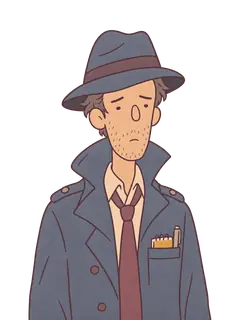



What Fabrice says
How they order
Fabrice has 17 written orders, heard over the year as the kitchen learns new fillings and techniques; after those, the game makes up more in the same voice. A few of them:
“Ham and cheese in a galette, square, like a file nobody reopens. Crisp. He was tired.”
In plain words Ham and Emmental on buckwheat. A square envelope. Crisp.


“Sour, then sweet, like a witness changing her story. Three sharp corners. Crisp.”
In plain words Lemon and sugar. A triangle. Crisp. The witness was a lemon.

“The full galette: ham, cheese, an egg. Four sides shut. Golden. The bank called it lunch.”
In plain words Ham, Emmental and egg on buckwheat. A square envelope. Golden.

“Salted caramel. Butter. Rolled tight, like a note slid under a door. Golden.”
In plain words Salted caramel and butter. Rolled. Golden. There was no note.


The usual
Once Fabrice has a favourite, the order stops being spelled out: the usual is La Forestière, crisp. It sounds like this: “The usual, he said, as if she kept a file on him.” See the usual.
Not sure what they mean? Ask. See orders.
Crêpes they love


Fabrice’s face is on those pages of the notebook.
Fabrice’s story: The publisher
A second story, “The publisher”, begins after the first ten days and unfolds over five visits, told a little at a time across the counter. Somewhere along it comes a question, and your answer changes one thing you will see and one thing the till feels. Both answers are kind; neither is wrong.
“A letter came for him at the bank. A publisher, real letterhead. He read it nine times.”
— how it begins
Spoiler The whole of “The publisher”, its question and its keepsake
- “A letter came for him at the bank. A publisher, real letterhead. He read it nine times.”
- “They liked the book. They wanted the crêpière to be wrong at the end. He said no. Twice.”
- “A reading at the bookshop. Three people came. One wore a moustache and sat at the back.” Armand: “I was not there. Had I been there, I would say chapter four drags. Hmph.”
- “The proofs came back. One page was blank: the dedication. He'd never dedicated anything.”
- “The book was out: 'Rain on the Griddle'. Two hundred copies. One signed for her shelf. (or, after the other answer: “The book was out. First page: 'For La Lanterne.' He'd signed a copy for her shelf. Here.”)”
The question: What should the dedication say?
- 'For La Lanterne.' Fabrice: “For La Lanterne. Three words. He'd written ninety thousand, and these were the hard ones.” (Fabrice drops in a little more often: 10% more visits.)
- 'For La Lanterne, and the rain.' Fabrice: “And the rain. Yes. Without the rain he'd only have had a crêperie. Not a story.” (Rainy days tip 5% more: the rain has a book now.)
Signed, first edition: 'Rain on the Griddle', signed on the title page in fountain pen. The ink ran a little.

Fabrice's first edition 'Rain on the Griddle', signed: 'To the cook, who solved it first. F.' The ink ran a little.
In the street’s second year
The story does not stop at the end of the first year: Fabrice has a postscript in the second.
Spoiler Fabrice’s postscript
- “A second printing. Three hundred copies. He'd asked them to keep the dedication. They had.”
- “A reader wrote from Penmarc'h. One line: 'The crêpière was right.' Signed M. He knew.”
- “He'd started a second book. Same street, different rain. He wasn't telling the ending.”
Who Fabrice knows


Around the street
You will hear from Fabrice at La Veillée des Citrouilles (October), Poisson d’Avril (April), Exam week (June), The reading night (September), Fog week (October), The candle evening (November), Rain week (February), Armand's truce (February), The bandstand on the square, Young plane trees and Lanterns the length of the street.
Fabrice also has a word to say in 12 of the street’s little moments.
Spoiler The chapters Fabrice has a part in
Fabrice turns up in The grey card, Lison's cart, When the season ends, The captain's question and Théo's cargo bike.
Presents
From Yann the pedlar’s cart, Fabrice would love a typewriter ribbon and a squared notebook.
Friendship
Spoiler What Fabrice says as you become friends
As you become friends:
- A regular: “He came back. He always came back. It was that kind of place.”
- A friend: “She knew his order. He pretended to be annoyed. He was not.”
- A dear friend: “Chapter nine was about a crêperie. He changed the name. Barely.”
- Family: “He dedicated the book to a crêperie. The publisher wept.”
When a present arrives:
- “The new ribbon made his sentences shorter. Critics rejoiced.”
- “He filled the notebook in a week. Mostly with crêpes.”
Back in the notebook: La Forestière. On the back, a library stamp: 'DUE BACK 14 MARCH 1994'.