
Guests
Esther
On this page
Their faces
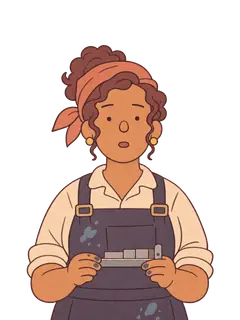
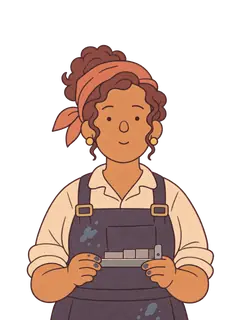
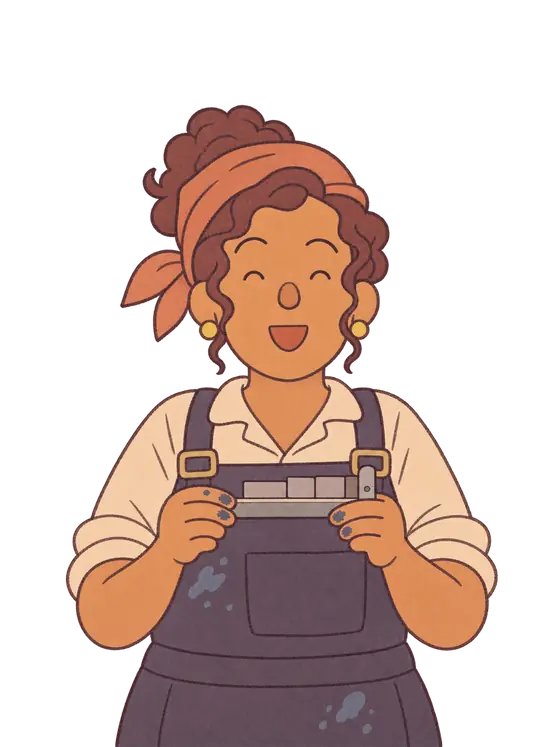
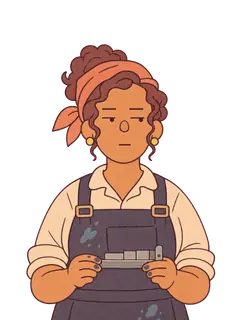
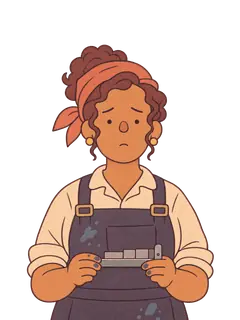
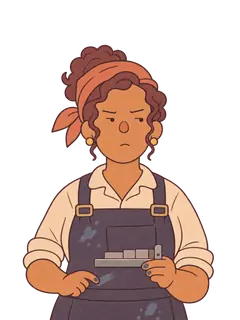


What Esther says
How they order
Esther has 8 written orders, heard over the year as the kitchen learns new fillings and techniques; after those, the game makes up more in the same voice. A few of them:
“Set it in bold: caramel. Butter underneath. Rolled like a proof sheet. Crisp.”
In plain words Salted caramel and butter. Rolled. Crisp.


“Hazelnut spread kerned close against the long yellow fruit. A triangle. Golden.”
In plain words Chocolate-hazelnut and banana. A triangle. Golden.


“Lemon and sugar, three corners. And golden, in italics, please.”
In plain words Lemon and sugar. A triangle. Golden.

“A galette complète, justified both sides, square on buckwheat. Crisp, a clean impression.”
In plain words Ham, Emmental and egg on buckwheat. A square envelope. Crisp.


In Esther’s words
When Esther makes an order up, these are the words for a fold and for how it is cooked:
| They mean | They say |
|---|---|
| Triangle | “folded to three corners” |
| Square envelope | “folded square, like a quire” |
| Rolled | “rolled like a proof sheet” |
| Pale and soft | “pale, in light type” |
| Golden | “golden, in italics” |
| Crisp | “crisp, a clean impression” |
The usual
Once Esther has a favourite, the order stops being spelled out: the usual is La Bigoudène, crisp. It sounds like this: “The usual. Caramel, in bold.” See the usual.
Not sure what they mean? Ask. See orders.
Esther’s story: The missing é
“The missing é” unfolds over four visits, told a little at a time across the counter. Somewhere along it comes a question, and your answer changes one thing you will see and one thing the till feels. Both answers are kind; neither is wrong.
“Basile's gazette goes out every week now. I set it all by hand. Every letter, every week.”
— how it begins
Spoiler The whole of “The missing é”, its question and its keepsake
- “Basile's gazette goes out every week now. I set it all by hand. Every letter, every week.”
- “I'm out of é's. Hélène's name takes two. This week she's 'Hlne'. She's taken it well.”
- “Borrow é's nearby, or beg them by post from other towns. Friday's paper won't wait.”
- “This week's paper, and every é where it belongs. One for you, on the good stock. (or, after the other answer: “This week's paper, every é cut from your menu board's hand. One for you, on good stock.”)”
The question: What can the shop do for Esther?
- Cut an é from my menu board's hand. Esther: “Your chalk é, cut in boxwood. It'll lean a little. I'll make it fit.” (The gazette prints in your own letter: renown +5%.)
- Ask Bastien to bring é's by post. Esther: “Bastien! He'll bring them first class. Or to the wrong door. Either way.” (Bastien brings one more postcard a week.)
From the press: A lead letter é, worn smooth. 'The hardest-working letter on the street.'

A lead letter é One sort of type, the letter é, from Esther's case. It has printed every gazette so far.
Who Esther knows


Presents
From Yann the pedlar’s cart, Esther would love a tin of red printing ink.
Friendship
Spoiler What Esther says as you become friends
As you become friends:
- A regular: “You're on my proof-reading list now. Just you and Basile.”
- A friend: “Basile wants you in the gazette. I've saved you a good column.”
- A dear friend: “I printed a card for your till: 'back in five minutes'. In italics.”
- Family: “Years of setting type, and no name I've liked better than your shop's.”
When a present arrives:
- “Red ink! The gazette's festive edition is sorted. Thank you.”