
Guests
Maître Jakez
On this page
Their faces
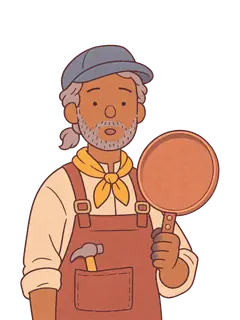
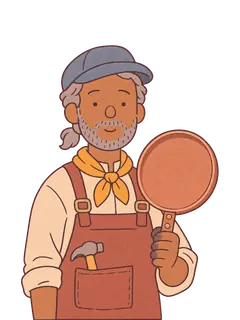
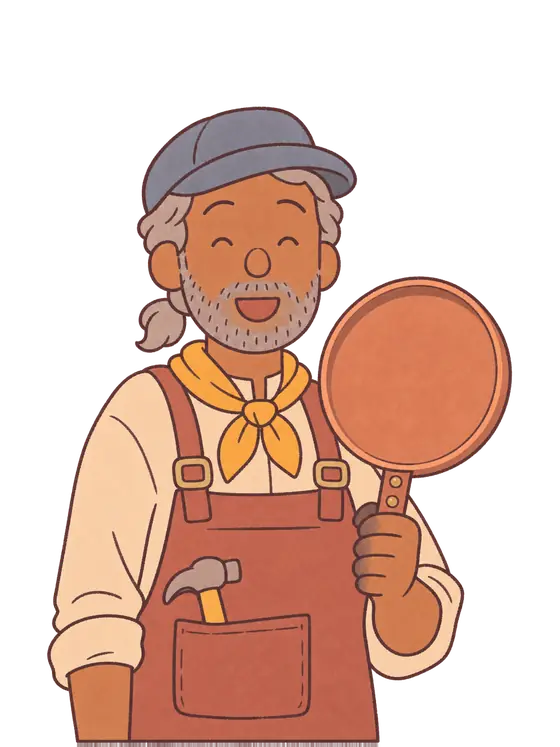
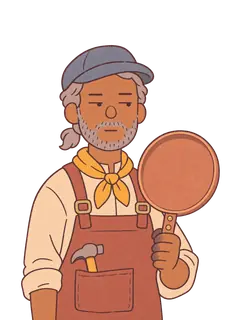
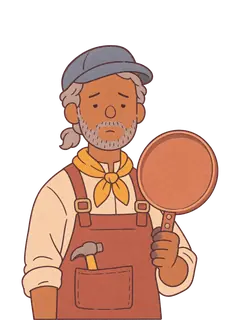
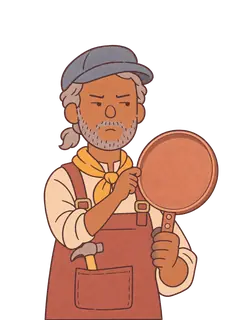


What Maître Jakez says
How they order
Maître Jakez has 18 written orders, heard over the year as the kitchen learns new fillings and techniques; after those, the game makes up more in the same voice. A few of them:
“Bilig, listen. Butter, three corners, golden. It's the Chandeleur. Your best.”
In plain words Butter. A triangle. Golden.

“La Pièce d'Or, for the coin in your other hand. Three corners. Golden.”
In plain words Candied orange, butter, and lemon and sugar. A triangle. Golden.

“Orange that sat a week in sugar, and what the bees make. Rolled. Golden.”
In plain words Candied orange and honey. Rolled. Golden.

“Candied orange under whipped cream. Four corners in. Pale. Easy on her.”
In plain words Candied orange and whipped cream. A square envelope. Pale and soft.

In Maître Jakez’s words
When Maître Jakez makes an order up, these are the words for a fold and for how it is cooked:
| They mean | They say |
|---|---|
| Triangle | “three corners, honest” |
| Square envelope | “four corners in, square as a lid” |
| Rolled | “rolled like copper sheet” |
| Pale and soft | “pale, easy on the heat” |
| Golden | “golden as polished copper” |
| Crisp | “crisp, ringing like tin” |
The usual
Once Maître Jakez has a favourite, the order stops being spelled out: the usual is La Toute Simple, golden. It sounds like this: “The usual. Butter. She knows.” See the usual.
Not sure what they mean? Ask. See orders.
Crêpes they love
Maître Jakez’s face is on those pages of the notebook.
Maître Jakez’s story: Maëlle's pan
“Maëlle's pan” unfolds over five visits, told a little at a time across the counter. Somewhere along it comes a question, and your answer changes one thing you will see and one thing the till feels. Both answers are kind; neither is wrong.
“That copper pan on your back wall. Maëlle's. I tinned it in '83. I know my rivets.”
— how it begins
Spoiler The whole of “Maëlle's pan”, its question and its keepsake
- “That copper pan on your back wall. Maëlle's. I tinned it in '83. I know my rivets.”
- “Her tin's polished thin. Years of a loving cloth. I'll re-tin her. No charge.”
- “Done on your pavement, with a fire the size of a hat. Mind the step. It's still warm.”
- “There. She shines like the day your aunt bought her. Now: what's she for?”
- “Every year I'll look at her and say one word. Today the word is: good. (or, after the other answer: “She's on the wall, and she's good. That's all I say about pans. Good.”)”
The question: What becomes of Maëlle's pan?
- Hang her back on the wall. Maître Jakez: “On the wall, then. Where she can watch the work. Good.” (A shining copper pan on the wall: ambience +1.)
- Cook one crêpe in her. Maître Jakez: “One crêpe. Her first in a long while. Butter. Don't rush her.” (The Chandeleur track counts one extra step.)
Stamped on your rozell: Maître Jakez stamped his mark, a J and a small star, into your rozell's handle.

The tinker's mark A J and a star stamped on your rozell's handle. He marks only the tools he'd stand behind.
In the street’s second year
The story does not stop at the end of the first year: Maître Jakez has a postscript in the second.
Spoiler Maître Jakez’s postscript
- “Another year on the road. Forty-one towns. Your pan's the one I thought of.”
- “Let me see her. ... Hm. ... Good.”
- “I take an apprentice next winter. She hums at the copper. That's a good sign.”
Their fair
Maître Jakez comes to the street with La Semaine de la Chandeleur, and comes back with it every year.
“Bonjour. Maître Jakez, tinker. I've come for the Chandeleur, and to look at your pans.”
“Crêpe week. Hold a coin when you flip, for luck. I hold a rivet. Same thing.”
Who Maître Jakez knows


Around the street
You will hear from Maître Jakez at La Semaine de la Chandeleur (January).
Presents
From Yann the pedlar’s cart, Maître Jakez would love a new leather apron and a pot of copper polish.
Friendship
Spoiler What Maître Jakez says as you become friends
As you become friends:
- A regular: “I'll look at your pans for nothing now. Don't tell the other streets.”
- A friend: “I've put your street on my winter round. On purpose.”
- A dear friend: “Your iron and mine are the two I'd trust. Mine's older.”
- Family: “A lot of road behind me. This counter's the one I'd stop at last.”
When a present arrives:
- “A new apron! The old one's more hole than apron. Thank you.”
- “Polish. I never buy it. Too proud. Thank you, then.”