
Guests
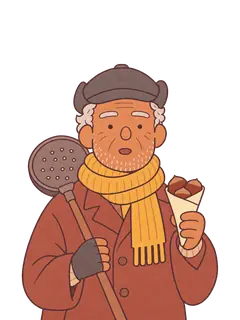
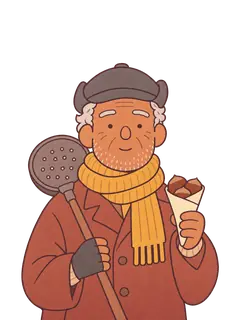
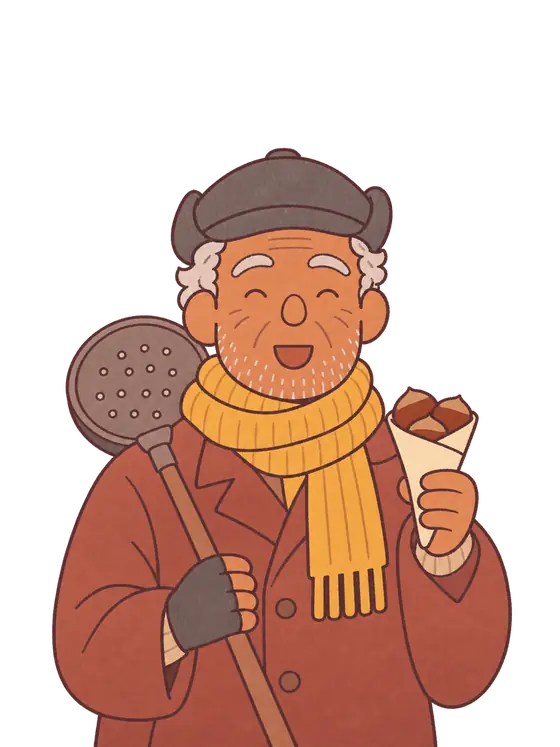
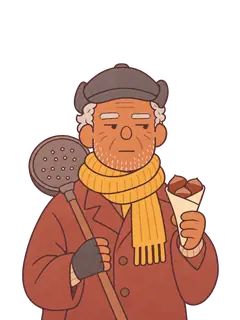
Père Goulven
On this page
Their faces
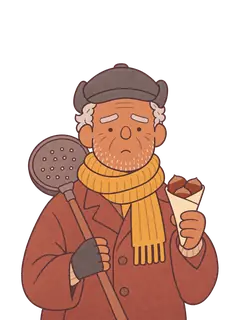
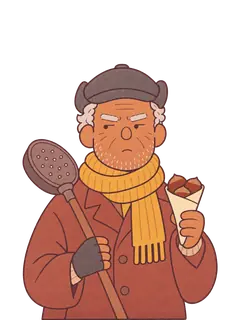


What Père Goulven says
How they order
Père Goulven has 18 written orders, heard over the year as the kitchen learns new fillings and techniques; after those, the game makes up more in the same voice. A few of them:
“Butter. Three corners. Crisp. Nothing else. My father's way.”
In plain words Butter. A triangle. Crisp.

“Chestnuts from my pan, on butter. Rolled. Golden. Hm.”
In plain words Roasted chestnuts and butter. Rolled. Golden.
“What cracks open in my pan, under white cream. Three corners. Golden.”
In plain words Roasted chestnuts and whipped cream. A triangle. Golden.

“Roasted chestnuts and honey. Three corners. Pale. For cold hands.”
In plain words Roasted chestnuts and honey. A triangle. Pale and soft.

In Père Goulven’s words
When Père Goulven makes an order up, these are the words for a fold and for how it is cooked:
| They mean | They say |
|---|---|
| Triangle | “three tight corners” |
| Square envelope | “a square parcel” |
| Rolled | “rolled like my scarf” |
| Pale and soft | “pale, hardly toasted” |
| Golden | “golden as a shell” |
| Crisp | “crisp, like frost” |
The usual
Once Père Goulven has a favourite, the order stops being spelled out: the usual is La Mont-Blanc, pale and soft. It sounds like this: “The usual. You know it.” See the usual.
Not sure what they mean? Ask. See orders.
Crêpes they love
Père Goulven’s face is on those pages of the notebook.
Père Goulven’s story: The brazier
“The brazier” unfolds over five visits, told a little at a time across the counter. Somewhere along it comes a question, and your answer changes one thing you will see and one thing the till feels. Both answers are kind; neither is wrong.
“Seventy Novembers at the brazier. I hum, in November. Only then. Don't ask why.”
— how it begins
Spoiler The whole of “The brazier”, its question and its keepsake
- “Seventy Novembers at the brazier. I hum, in November. Only then. Don't ask why.”
- “My grandson, Tanguy. Wants the brazier. Afraid of the fire. Clever boy.”
- “Brought Tanguy. He's outside, watching your griddle through the glass. That's the start.”
- “He asked how you know a crêpe is done. I said: ask her.”
- “Tanguy sold his first cone today. Burnt on one side. Sold it anyway. Good boy. (or, after the other answer: “Tanguy sold his first cone. Took them off by the colour. Like you. Hm.”)”
The question: How should Tanguy learn?
- Show him how I watch the colour. Père Goulven: “Watching. Yes. That's the whole trade. He'll be here at eight.” (Chestnut crêpes tip 10% more.)
- Let Goulven teach him his way. Père Goulven: “My way. Slow. With a stool. He'll grumble. Good.” (The Saint-Martin track counts one extra step.)
From the brazier: A paper cone with one chestnut in it, varnished hard: 'Tanguy's first. Keep it warm.'

A varnished chestnut cone Tanguy's first cone from the brazier, one chestnut inside, varnished by Goulven so it keeps.
In the street’s second year
The story does not stop at the end of the first year: Père Goulven has a postscript in the second.
Spoiler Père Goulven’s postscript
- “Tanguy lights the brazier now. I bring the stool. Fair trade.”
- “He hums. In November. I never taught him. It came by itself.”
- “Seventy-one Novembers. Tanguy's first. Can't tell which is better. Hm.”
Their fair
Père Goulven comes to the street with La Saint-Martin, and comes back with it every year.
“Mm-mm. Mm. November. Seventy of them, petite. Bonjour.”
“The Saint-Martin. Brazier's lit. Come and smell it.”
Who Père Goulven knows


Around the street
You will hear from Père Goulven at La Saint-Martin (November).
Presents
From Yann the pedlar’s cart, Père Goulven would love a pair of fingerless gloves and a tin of paper cones.
Friendship
Spoiler What Père Goulven says as you become friends
As you become friends:
- A regular: “Saved you the fattest chestnut. Don't tell.”
- A friend: “You watch the colour like I listen to the shell. Good.”
- A dear friend: “Tanguy asks about you. I told him: good hands. He wrote it down.”
- Family: “My brazier's warm, petite. Your counter's warmer. Don't tell it.”
When a present arrives:
- “Gloves. Two of them. I only had the one. Merci, petite.”
- “Cones. Ready-folded. Tanguy will be pleased. So am I.”