
Guests
Agathe
On this page
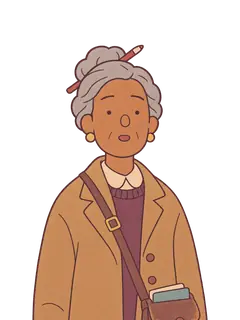
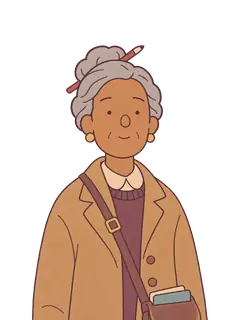
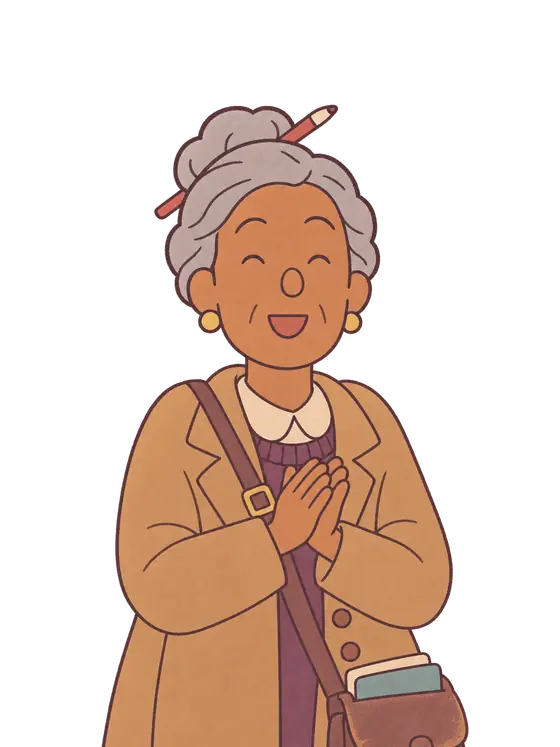
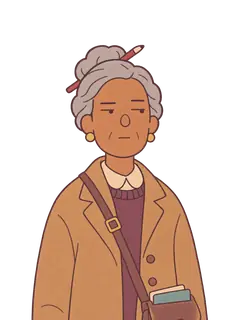
Their faces
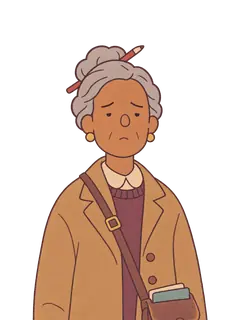
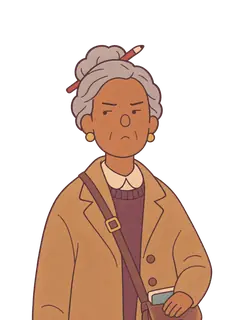


What Agathe says
How they order
Agathe has 18 written orders, heard over the year as the kitchen learns new fillings and techniques; after those, the game makes up more in the same voice. A few of them:
“Raspberry jam, rolled like a diploma. Golden. The classics, in order.”
In plain words Raspberry jam. Rolled. Golden.

“A golden triangle with lemon and sugar, please. Lovely board, by the way. One comma.”
In plain words Lemon and sugar. A triangle. Golden.

“The fruit my pupils left on my desk, stewed, over butter. Rolled. Golden.”
In plain words Apple compote and butter. Rolled. Golden.


“Butter, three tidy corners, pale. Please and thank you, as I used to tell Fañch.”
In plain words Butter. A triangle. Pale and soft.
In Agathe’s words
When Agathe makes an order up, these are the words for a fold and for how it is cooked:
| They mean | They say |
|---|---|
| Triangle | “three ruled corners” |
| Square envelope | “a square, like a letter home” |
| Rolled | “rolled like a diploma” |
| Pale and soft | “pale, if you please” |
| Golden | “golden as a gold star” |
| Crisp | “crisp as a new exercise book” |
The usual
Once Agathe has a favourite, the order stops being spelled out: the usual is La Rouge-Gorge, golden. It sounds like this: “My usual, please. You know it by heart.” See the usual.
Not sure what they mean? Ask. See orders.
Agathe’s story: Old pupils
“Old pupils” unfolds over five visits, told a little at a time across the counter. Somewhere along it comes a question, and your answer changes one thing you will see and one thing the till feels. Both answers are kind; neither is wrong.
“Galette Royale's menu. I know that hand. Armand, 1979, third row, by the window.”
— how it begins
Spoiler The whole of “Old pupils”, its question and its keepsake
- “Galette Royale's menu. I know that hand. Armand, 1979, third row, by the window.”
- “I kept his composition: 'When I grow up I will be a crêpe.' A crêpe, Madame. Not a cook.”
- “Armand came over this morning, very pink. He asked me, as a gentleman, not to read it out.” Armand: “Hmph. That document is juvenilia, Madame Agathe. I was eight. Lose it. No. Keep it.”
- “My Sunday tour wants a story from the street. I have one in my satchel. Shall I?”
- “I gave Armand his composition back today. He read it twice and put it in his waistcoat. (or, after the other answer: “I gave Armand the composition, sealed. He didn't open it. He tucked it in his waistcoat.”)”
The question: What should Agathe do with the essay?
- Keep it between you and Armand. Agathe: “Very well. A good teacher knows when to close the book. He'll be so relieved.” (A grateful Armand sends two of his queue across, once.)
- Read it on her Sunday tour, kindly. Agathe: “Gently, then, and with his permission, which I shall get. He was a charming eight.” (The Patrimoine tour asks for the story again: one more guest every Patrimoine day.)
A gold star: Agathe's gold star, pressed on the corner of your menu board: 'For neatness, kindness and butter.'

A gold star on the menu board Agathe's star, stuck in the top corner of the board. She says it is for the whole street, really.
In the street’s second year
The story does not stop at the end of the first year: Agathe has a postscript in the second.
Spoiler Agathe’s postscript
- “Monsieur Maxime has asked me into his class to talk about 1979. I've sharpened my pencil.”
- “The children asked what Armand was like at eight. I said: exactly the same, only smaller.”
- “Capucine asked to borrow my red pencil. I lent it. I expect it back with marks out of ten.”
Who Agathe knows


Around the street
You will hear from Agathe at Les Journées du Patrimoine (September) and The school visit (May).
Agathe also has a word to say in 1 of the street’s little moments.
Spoiler The chapters Agathe has a part in
Agathe turns up in The cold oven and The lost recipe card.
Presents
From Yann the pedlar’s cart, Agathe would love a tin of coloured chalks and a gold-star stamp.
Friendship
Spoiler What Agathe says as you become friends
As you become friends:
- A regular: “You've a good hand at the griddle, Madame. I always notice hands.”
- A friend: “I keep a little exercise book about your crêpes now. All gold stars.”
- A dear friend: “If I'd had a pupil like you, I'd have kept in touch. Well, here I am.”
- Family: “Forty years of pupils, and you're the one who has taught me something.”
When a present arrives:
- “Coloured chalk! I could do your menu board. Only if you ask.”
- “A gold-star stamp. Now I can give them out faster. Thank you.”