
Guests
Gwen
On this page
Their faces
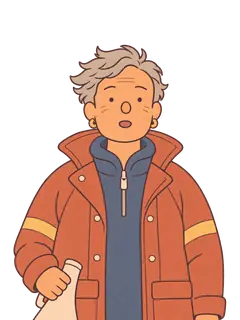
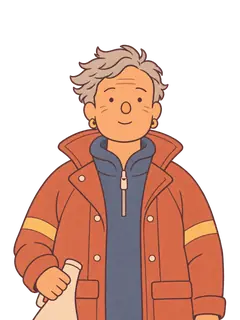
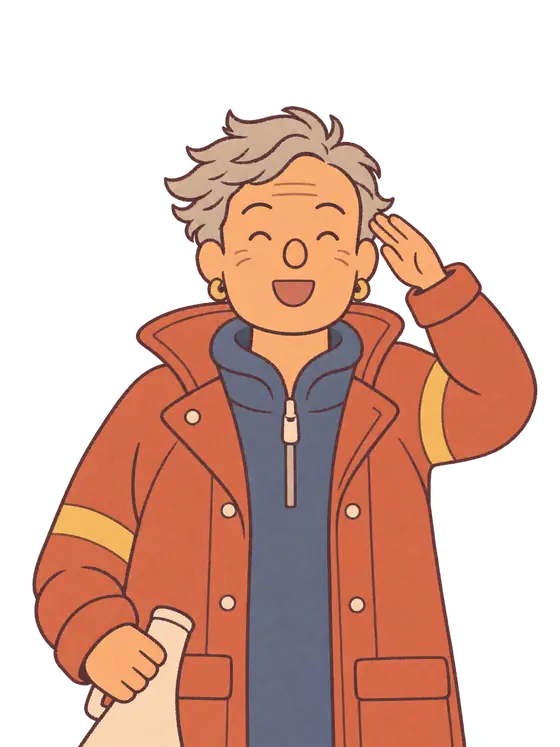
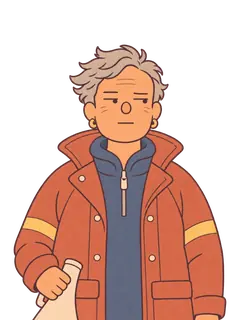
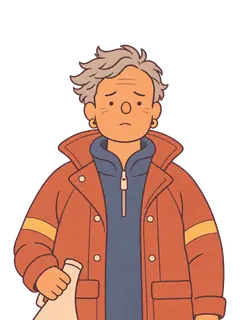
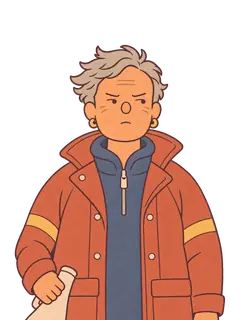


What Gwen says
How they order
Gwen has 18 written orders, heard over the year as the kitchen learns new fillings and techniques; after those, the game makes up more in the same voice. A few of them:
“Tomato, ham and egg on buckwheat. Square. Crisp. Flood at nine.”
In plain words Tomato, ham and egg on buckwheat. A square envelope. Crisp.


“Smoked salmon, crème fraîche, buckwheat, square. Crisp. High water at four.”
In plain words Smoked salmon and crème fraîche on buckwheat. A square envelope. Crisp.


“A galette, full cargo: ham, cheese, egg. Square. Crisp. Low water at eleven.”
In plain words Ham, Emmental and egg on buckwheat. A square envelope. Crisp.

“Lardons, cheese and crème fraîche on buckwheat. Square, crisp. Low water at five.”
In plain words Lardons, Emmental and crème fraîche on buckwheat. A square envelope. Crisp.

In Gwen’s words
When Gwen makes an order up, these are the words for a fold and for how it is cooked:
| They mean | They say |
|---|---|
| Triangle | “a triangle, like a pennant” |
| Square envelope | “square, like a berth” |
| Rolled | “rolled like a line” |
| Pale and soft | “pale as a dawn tide” |
| Golden | “golden as the harbour light” |
| Crisp | “crisp as a north wind” |
The usual
Once Gwen has a favourite, the order stops being spelled out: the usual is La Nordique, crisp. It sounds like this: “The usual. Tide waits for nobody.” See the usual.
Not sure what they mean? Ask. See orders.
Crêpes they love

Gwen’s face is on those pages of the notebook.
Gwen’s story: The harbour lantern
“The harbour lantern” unfolds over five visits, told a little at a time across the counter. Somewhere along it comes a question, and your answer changes one thing you will see and one thing the till feels. Both answers are kind; neither is wrong.
“The town wants an electric lamp at the harbour mouth. The old lantern comes down Friday.”
— how it begins
Spoiler The whole of “The harbour lantern”, its question and its keepsake
- “The town wants an electric lamp at the harbour mouth. The old lantern comes down Friday.”
- “Ninety years it's brought boats in. I won't have it in a cupboard. It wants lighting.”
- “Got it in my office now, cleaned up. Brass and red glass. I need a place for it, Madame.”
- “Your yard, or the Captain's little rowing boat. Both would light it. You choose. I can't.”
- “Lit it last night. Red glass, ninety years old, and every boat came home on time. (or, after the other answer: “Lit it in your yard last night. You can see it from the quay. I checked. Twice.”)”
The question: Where should the lantern go?
- Hang it in my yard. Gwen: “Your yard it is. I'll light it at dusk on my way home. Every evening.” (The first evening it is lit, the street brings you a sugar pearl.)
- Give it to the Captain's doris. Gwen: “The Captain's doris! Best-lit rowing boat on the coast. He'll pretend not to be moved.” (Lucien tips 10% more on his visits.)
From the harbour entrance: The lantern's old wick, coiled in a small tin: 'Ninety years of boats came home by it.'

The harbour lantern's wick Coiled in a small tin. It lit the harbour entrance for ninety years.
In the street’s second year
The story does not stop at the end of the first year: Gwen has a postscript in the second.
Spoiler Gwen’s postscript
- “The electric lamp at the entrance blinks. The old one never blinked. Just saying.”
- “My nephew has painted his boat's name again. Better letters. I said nothing. Proudly.”
- “Put a new wick in the old lantern this spring. Same light. Good as ever.”
Who Gwen knows


Around the street
You will hear from Gwen at La Semaine de la Mer (August), The great tide (August), Fog week (October) and Young plane trees.
Gwen also has a word to say in 4 of the street’s little moments.
Gwen is at the heart of The year of the tall ship.
Spoiler The chapters Gwen has a part in
Gwen turns up in The captain's question.
Presents
From Yann the pedlar’s cart, Gwen would love a framed tide table and a pair of thick wool socks.
Friendship
Spoiler What Gwen says as you become friends
As you become friends:
- A regular: “I've put La Lanterne on my harbour map. In pencil, for now.”
- A friend: “In ink now. La Lanterne: a good berth.”
- A dear friend: “The Captain says you're the best galley on the coast. He's right.”
- Family: “If you ever need a mooring, Madame, you've got one. For life.”
When a present arrives:
- “A framed tide table! I know it by heart. I'll hang it anyway.”
- “Wool socks. My sea boots won't know what's hit them.”